
In enterprise environments, server room infrastructure defines how IT equipment is physically housed, powered, cooled, secured, and maintained. Proper server room design ensures system reliability, safe operation, scalability, and reduced risk of downtime.
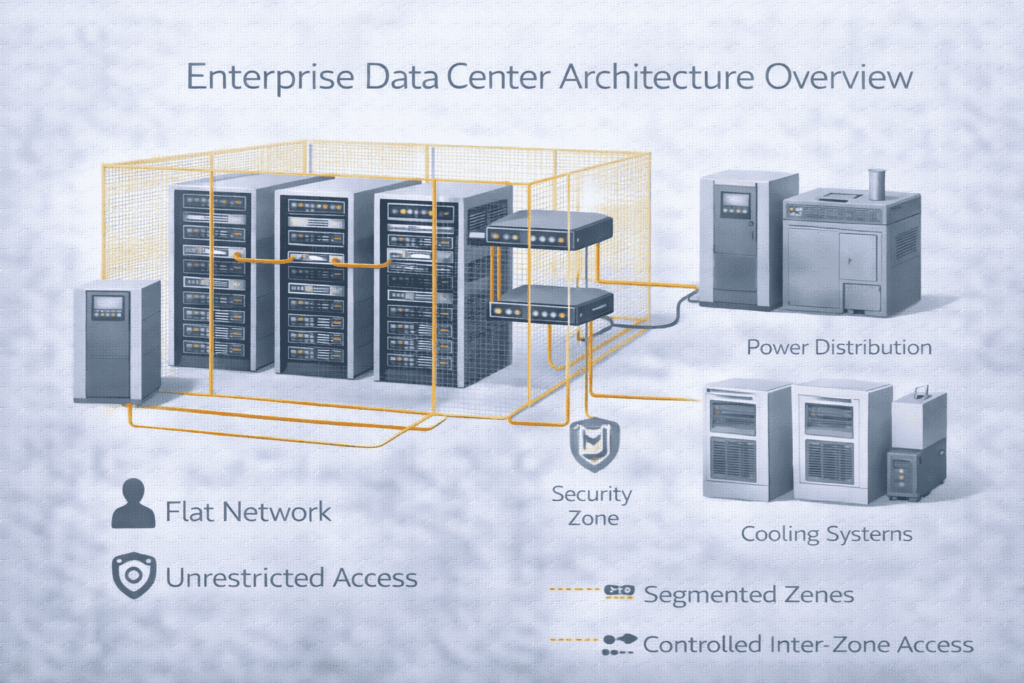
Engaging an expert in enterprise server room design is crucial at these key junctures:
New Office or Facility Build: Incorporate a correctly sized, properly located server room into blueprints from day one.
Consolidation of Scattered IT Systems: Merge multiple equipment closets into one centralized, secure, and manageable hub.
Aging or Poorly Designed Existing Rooms: Modernize outdated spaces that lack adequate cooling, power, or organization, posing a constant risk.
Immediate Power, Cooling, or Space Constraints: When you cannot add new equipment without overloading circuits or causing overheating.
New Security or Access Control Mandates: Meet compliance or insurance requirements with robust physical security and monitoring.
Strategic Preparation for Future Growth: Design a room that can scale, serving as a springboard for future data center expansion.
Many day-to-day IT struggles and risks originate from these foundational oversights:
Servers in Non-Dedicated Rooms: Using a repurposed closet without proper environmental controls guarantees premature hardware failure.
Insufficient Cooling and Airflow: Relying on office air conditioning leads to dangerous hot spots that silently damage equipment.
No Power Redundancy: A single power circuit or an undersized UPS means a minor outage will take your entire operation offline.
Poor Cable Management and Labeling: A tangled web of cables makes troubleshooting a nightmare and changes slow and risky.
Lack of Physical Security and Monitoring: An unlocked door and no environmental alerts leave you vulnerable to intrusion and undetected failures.
These issues significantly increase the risk of failure and quietly inflate long-term operational costs.
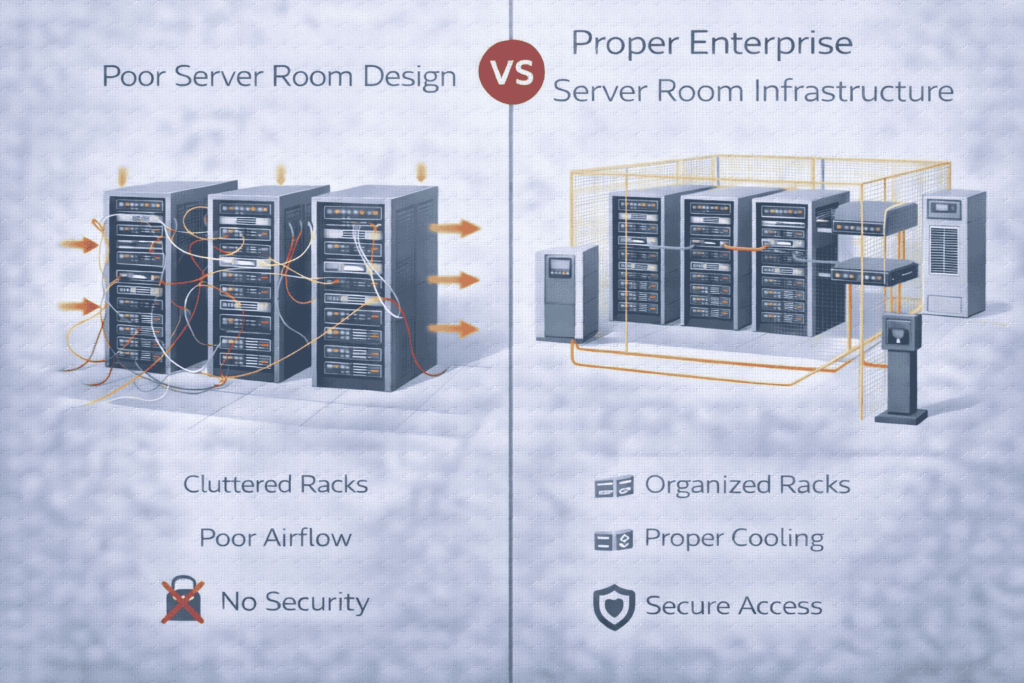
We treat your server room with the same rigor as a mission-critical facility. Our infrastructure-first methodology ensures resilience and operational clarity.
Strategic Space and Rack Layout Planning: We design efficient floor plans and rack arrangements (like hot aisle/cold aisle) to maximize cooling and serviceability.
Comprehensive Power Capacity and Redundancy Design: We calculate total load, design dedicated electrical circuits with headroom, and specify UPS/generator systems for clean, continuous power.
Precision Cooling and Airflow Management: We size dedicated cooling units to handle the heat load, ensuring stable temperature and humidity to prolong equipment life.
Layered Physical Security and Access Zoning: We implement access controls, logging, and safety systems to protect assets from physical threats.
Structured Cabling and Labeling Standards: We install organized cable pathways and a clear labeling system so every connection is instantly identifiable.
Detailed Documentation for Operations and Audits: We deliver “as-built” drawings, rack diagrams, and maintenance protocols for smooth operations and compliance.
We design server rooms as vital infrastructure, not merely equipment storage spaces.
A well-designed server room is the cornerstone that connects and supports your entire technology stack:
Enterprise Network Backbone: Serves as the primary junction for high-speed, redundant connections to your wider network.
Server, Storage, and Virtualization Platforms: Provides the stable, scalable foundation these critical workloads require.
Backup and Disaster Recovery Systems: Allocates secure, powered space for backup appliances and ensures robust connectivity for data replication.
Unified Monitoring and Alerting: Integrates temperature, humidity, and security sensors into your IT management dashboards for proactive oversight.
Physical Security Systems: Connects access logs and surveillance with your organization’s overall security management.
Your server room must operate as an integrated component of your larger IT and business ecosystem.
Our designs are engineered to deliver lasting value and meet stringent requirements:
Planned Growth Capacity: Allocating clear space and power capacity for future racks avoids premature, costly relocation.
Redundant Power and Cooling Paths: Designing N+1 systems ensures maintenance or a single component failure does not cause an outage.
Safe, Efficient Maintenance Access: Creating clear layouts and safety procedures so technicians can service equipment without risk.
Proactive Environmental Monitoring: Implementing 24/7 monitoring with alerts to prevent issues before they cause damage or downtime.
Inherent Audit and Compliance Readiness: Building to recognized standards and providing the documentation required for certifications like SOC 2 or ISO 27001.
An enterprise-grade server room is a dedicated, controlled environment built for maximum reliability. Key hallmarks include: redundant power with backup (UPS/generator), precision cooling independent of office HVAC, strict physical security with access logging, organized cable management, and 24/7 monitoring for environmental conditions. It is systematically designed, not improvised.
Always plan for significant growth. For space, allocate room for all current equipment plus 50-100% additional floor space for future racks. For power, calculate your total current wattage, then add a minimum of 30-50% extra capacity for immediate headroom and future expansion. Installing dual, redundant power circuits from the start is non-negotiable for availability.
The top causes are environmental: overheating from poor cooling design and power issues from inadequate electrical planning. These are followed by human error during maintenance in a poorly organized space, and security lapses like unauthorized physical access or undetected water leaks.
Think of it as a difference in scale, complexity, and redundancy. A server room supports a single organization’s local IT operations, often within an office building. A data center is a larger, specialized facility designed to house critical infrastructure for many organizations, with much higher levels of built-in redundancy (power, cooling, network), security, and capacity.
Act when you see these warning signs:
1) You’re out of space, power, or cooling for new equipment.
2) You experience frequent overheating alarms or mysterious hardware faults.
3) You postpone necessary maintenance for fear of triggering an outage.
4) Your security or compliance requirements have surpassed the room’s current capabilities.
5) Your business growth plans depend on an IT foundation that is already at its limits.
Proactive redesign is a strategic investment; reactive fixes are costly.
Whether you’re designing a new server room or fixing an existing one, HLIT delivers engineering-driven server room infrastructure designs built for reliability, security, and growth.
