
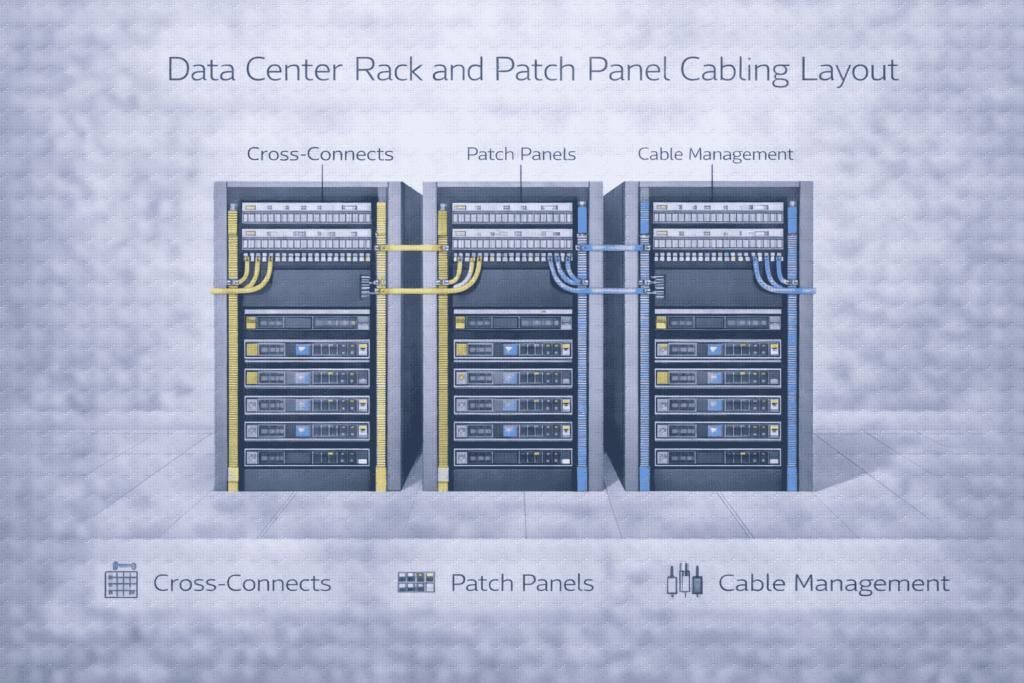
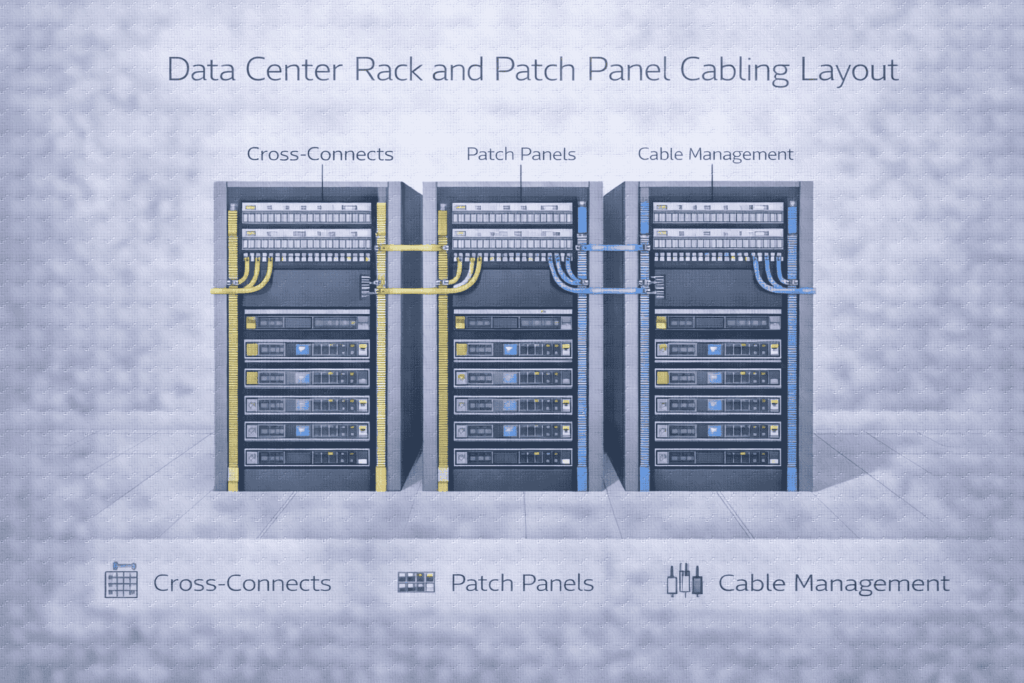
In enterprise data centers, structured cabling defines how fiber and copper cables are organized, terminated, labeled, and managed across racks, patch panels, and backbone pathways. Proper cabling design ensures signal integrity, scalability, ease of maintenance, and long-term operational reliability.
The mistakes listed are pervasive and create compounding operational debt:
No Separation of Cabling Types → Difficulty in maintenance, troubleshooting, and upgrades.
Poor Documentation/Labeling → Drastically extended Mean Time to Repair (MTTR) during incidents.
Excess Cable Length & Poor Routing → Blocked airflow, impaired cooling, and signal degradation.
Mixed Standards → Inconsistent operations, inventory complexity, and human error.
Cabling as an Afterthought → Results in all the above; it forces design into constraints rather than enabling it.
This creates “hidden downtime”—hours lost tracing cables, performing risky changes, and diagnosing network issues—along with inflated long-term capital costs for remediation.
Many day-to-day IT struggles and risks originate from these foundational oversights:
Servers in Non-Dedicated Rooms: Using a repurposed closet without proper environmental controls guarantees premature hardware failure.
Insufficient Cooling and Airflow: Relying on office air conditioning leads to dangerous hot spots that silently damage equipment.
No Power Redundancy: A single power circuit or an undersized UPS means a minor outage will take your entire operation offline.
Poor Cable Management and Labeling: A tangled web of cables makes troubleshooting a nightmare and changes slow and risky.
Lack of Physical Security and Monitoring: An unlocked door and no environmental alerts leave you vulnerable to intrusion and undetected failures.
These issues significantly increase the risk of failure and quietly inflate long-term operational costs.
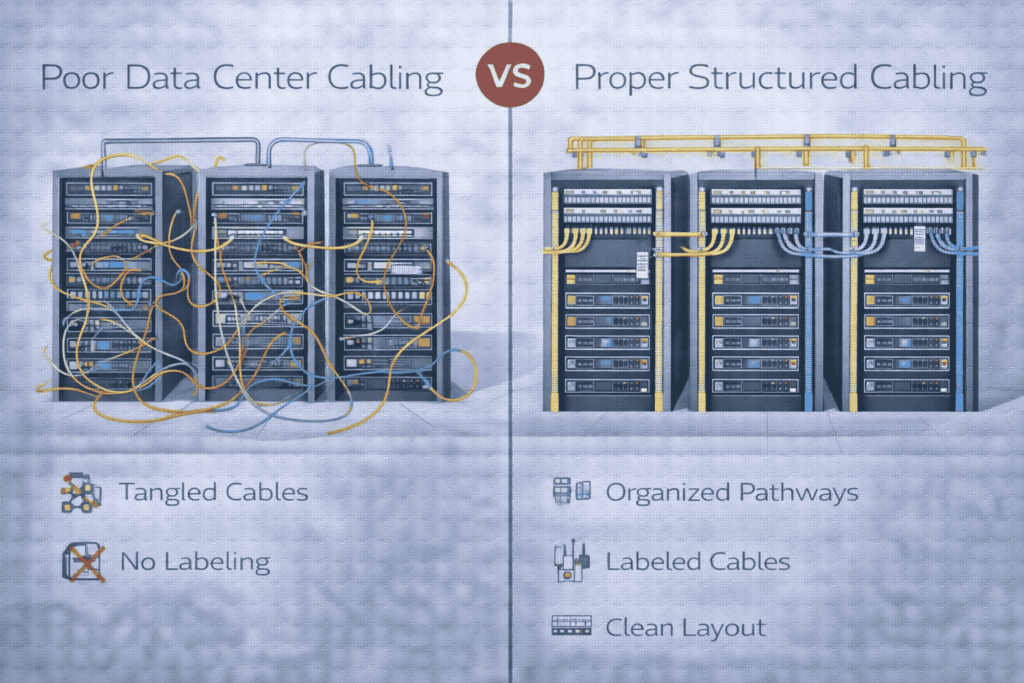
HLIT’s approach treats cabling as critical, long-lifecycle infrastructure, not disposable accessories. The core tenet is designing with standards (TIA-942, ISO/IEC 11801) and future capacity from day one.
This disciplined methodology ensures:
Predictability: Every port, panel, and pathway has a known purpose and destination.
Operational Efficiency: Technicians can safely, quickly, and accurately make changes.
Performance Integrity: Adherence to bend radius, length, and separation guarantees signal quality.
Investment Protection: The infrastructure supports multiple generations of active equipment.
As you correctly frame it, a clean cabling design is the central nervous system that enables all other systems to function. It must be integrated with:
IT Infrastructure: Server NIC layouts, storage network requirements, and network architecture tiers (core, aggregation, access).
Physical Infrastructure: Alignment with hot/cold aisles, avoidance of power pathways, and support for security zoning.
Management Systems: Documentation ties into DCIM for end-to-end circuit tracing and capacity management.
Performance, scalability, and compliance hinge on:
Speed Readiness: Deploying fiber types (OM4/OM5, OS2) and categories (Cat 6A/8) that support next-gen speeds.
Logical Separation: Distinct pathways or color-coding for production data, management, storage, and backup networks.
Pathway Professionalism: Using proper ladder rack, containment, and cabling trays to protect integrity and enable changes.
Standards Adherence: Compliance with TIA or ISO standards is not just technical; it’s a governance and audit requirement.
Living Documentation: As-built diagrams, labeling schemes, and port registers are operational necessities.
A: It is the foundational layer that all IT services depend upon. A poorly designed cabling plant directly causes network instability, limits scalability, increases downtime, and makes routine operations expensive and risky. It is the single hardest infrastructure component to retrofit.
A: Copper (Cat 6A/8) is primarily for short-reach connections (ToR switches, server NICs, power-over-Ethernet), typically under 30m. Fiber (Multimode/Single-mode) is for high-speed, long-distance runs (switch-to-switch backbone, SAN, cross-connects between rows/buildings), supporting speeds from 10G to 400G+ over kilometers.
A: The primary standards are the TIA-942 (Telecommunications Infrastructure Standard for Data Centers) and ISO/IEC 11801. These define hierarchy (backbone vs. horizontal), redundancy levels, distance limits, testing requirements, and documentation practices.
A: Directly and severely. Excess length, tight bends, or interference can cause packet loss and latency. Spaghetti-like cable bundles block airflow, causing overheating. Unlabeled cables massively prolong troubleshooting and repair times during an outage, turning minutes into hours.
A: Undertake a redesign when:
1) You are migrating to a new speed tier (e.g., 10G to 25/100G),
2) The cabling plant is unmanageable and undocumented, impacting operations,
3) You are undergoing a major consolidation or physical move, or
4) An audit or compliance requirement mandates standards adherence.
Bottom Line: A strategic investment in structured cabling design is an investment in operational agility, resilience, and total cost of ownership. It is the silent multiplier for every other technology deployed in the data center.
Whether you’re building a new data center or fixing legacy cabling issues, HLIT delivers engineering-driven structured cabling designs that support performance, growth, and operational clarity.
